
Okfuskee VINELink Custody Coverage
Oklahoma calls the statewide service OK VINE and provides online access through VINELink. The Attorney General describes it as a confidential, computer-assisted custody information and notification service. A person may check anonymously online, by mobile app, or by calling 1-877-654-8463. Status support operates around the clock, and the state describes language access in more than 240 languages. Alert methods can include app, telephone, email, text, and TTY.
Coverage still must be tied to a reporting agency. State materials support ODOC participation, subject to Oklahoma-specific limits. No official county-by-county list was found that proves the Okfuskee County Jail feed. Search the live system for the agency or call the service before relying on it. John H. Lilley Correctional Center belongs to ODOC, even though it is in Okfuskee County. Its event path differs from a county jail booking.
A VINE result is not a universal released-inmate archive. It reports the custody status, location, event, and alert options that a participating agency supplies. The service does not decide a criminal case. It also does not prove that supervision ended or that no other hold exists.
Search One Okfuskee Inmate on VINELink
Use the direct Oklahoma VINELink person search. Beginning in the state-specific portal avoids a result from another jurisdiction. Gather the exact name and any known identifier first. Names can be shared, misspelled, or entered in a different form, so the first result should never be accepted without comparison.
- Open Oklahoma's People search. Confirm that Oklahoma is the selected state before entering a name.
- Enter the person's name or available identifying number. Try a reasonable spelling variant only if the exact search gives no match.
- Compare the reporting agency, age or identity details, and any identifier. Reject a same-name result that does not fit.
- Open the matching custody record. Read the exact agency-supplied status, location, and event wording.
- If release or another custody change appears, contact that jail or ODOC to verify it. If no result appears, test the spelling and contact the likely custodian.
The official Oklahoma search screen below shows the correct entry point. Open the same live Oklahoma person search to check current fields.
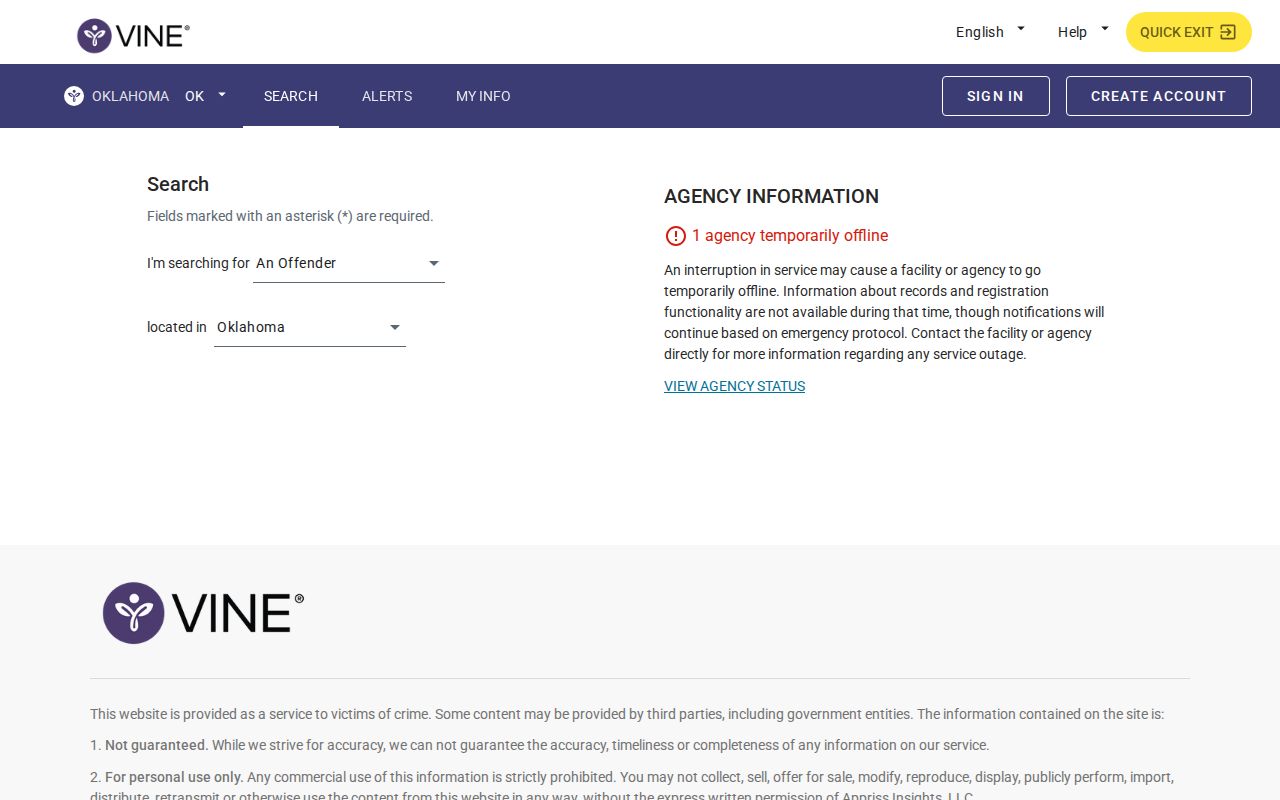
The state selector and person-search controls help narrow the query, but the matching record still needs an identity check and agency confirmation.
A person released directly from Okfuskee County Jail may leave the live jail view, while a state prisoner may remain in ODOC records with a changed status. If the last custodian is unclear, the Okfuskee County released inmate search separates county, state, court, and federal routes.
Note: No VINELink match can reflect a spelling issue, transfer, reporting delay, or coverage gap, not necessarily a release.
Okfuskee VINELink Release Fields
Field labels depend on what the reporting custodian sends. Read them literally. A release or custody-change event can document a reported event and date. It does not explain the court disposition behind the event. It also does not erase a warrant, show that parole ended, or establish that a transfer placed the person in the community.
| Field or element | How to read it |
|---|---|
| Reporting agency | Identifies the jail or state system that supplied the custody record. |
| Identity details | Help distinguish people with the same or similar name. |
| Custody status | States the agency's current supplied status; it should be confirmed at the source. |
| Location or event | May identify a facility, transfer, release, or other recorded custody change. |
| Notification options | Shows available channels for alerts tied to that specific record. |
A county release and a state discharge are not the same record. For Okfuskee County Jail, the Sheriff's existing jail-register date or manner of discharge is stronger direct proof. For JLCC or another ODOC facility, verify the state status and discharge record. OSCN supplies the related court action, but a court order may precede the actual exit process.
Register Okfuskee VINELink Release Alerts
Registration begins inside the correct person's custody record. Do not register from a same-name record without comparing the agency and identifiers. The offered channels can vary. Oklahoma's official program materials support phone, text, email, app, and TTY options, while the live prompt controls the exact confirmation step for each method.
- Open the verified custody record and select “Get Notified,” or call 1-877-654-8463.
- Choose one of the methods offered for that record, such as app, telephone, email, text, or TTY.
- Enter and confirm the requested contact details. For the traditional phone workflow, create a four-digit PIN.
- Complete the live channel confirmation. Automated phone calls ask for the PIN, while app, email, or text can use account or contact verification.
- Keep the registration details. When a consequential alert arrives, call the reporting custodian and confirm the event.
The Oklahoma Attorney General's OK VINE page describes the service and enrollment channels. Its official view appears below.
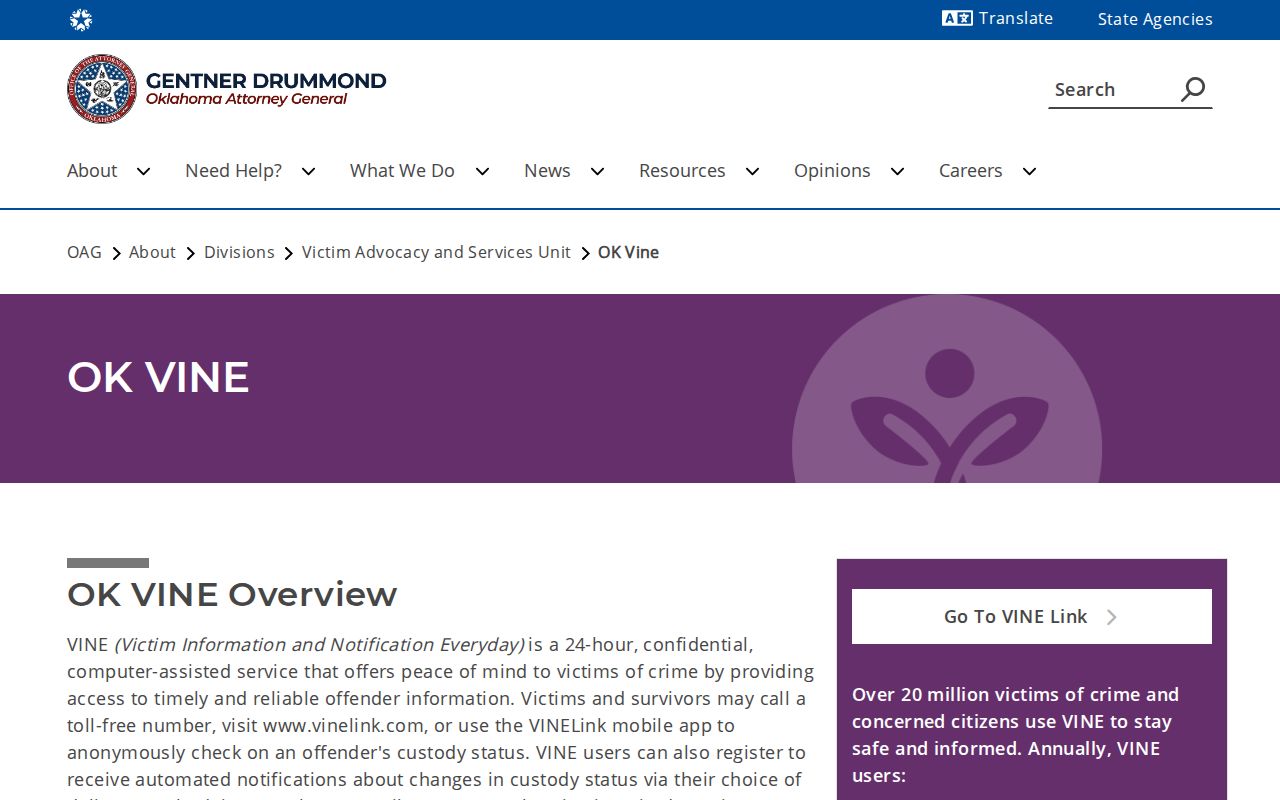
The state page confirms the available service routes. The selected person's live record remains the place to follow the exact registration prompt.
Notifications are aids, not certified records. Phone numbers and email addresses can change, calls can be missed, and agency data can arrive late. Keep contact information current and use more than one offered channel when that fits the need.
Confirm an Okfuskee VINELink Release
A VINE alert should lead to a source check. For an Okfuskee County Jail event, call 918-623-1122 and ask for the current records route. Request the existing jail-register field that shows the date or manner of discharge or escape. That Oklahoma statutory wording helps distinguish lawful release from transfer or escape. For a JLCC event, use ODOC Offender Lookup and state discharge records.
Federal custody sits outside this service. The Bureau of Prisons locator is the route for a federal inmate and can show a release date or a “RELEASED” label. ICE's locator is for current detention location, not historical release. USMS does not provide a matching public historic locator. No result in one system should be stretched into a conclusion about another.
Released and still in custody also require different records. A live roster answers who is held now. A released person may be absent from it. The jail discharge entry, state status history, or later agency response confirms what happened after the person left the live list.
Note: Treat “transferred” as continued custody until the receiving agency or a later discharge record shows otherwise.
Okfuskee Release Alert Follow-Up Records
An alert gives a useful time marker, but the next source depends on the event. If the Okfuskee County Jail reported release, ask the Sheriff for the existing jail-register or booking entry. Oklahoma law expressly supports access to the prisoner's name, commitment details, and the date or manner of discharge or escape when that record exists. Ask separately for an actual release timestamp, authority, transfer destination, or hold notation if kept and nonexempt. The agency does not have to create a new report that it does not maintain.
A court docket answers why a departure may have been authorized. The county-filtered OSCN record can show bond, dismissal, judgment, sentence, warrants, and revocation. Yet a court timestamp is not always the time of physical exit. Staff may still process identity, property, and holds. Pair the legal order with the custodial event rather than choosing one source and ignoring the other.
State custody calls for ODOC records. A person sentenced in Okfuskee County may wait at the jail before transfer, then appear in the state system. A transfer alert means the custodian changed. It does not mean the person returned to the community. Later ODOC status, discharge documentation, and supervision records provide the needed follow-up.
- Custody event
- An agency-supplied change such as release, transfer, or movement.
- Transfer
- A move to another custodian, not a community release.
- Discharge
- The responsible agency's recorded end of custody or supervision.
- Detainer
- A request or legal basis for another authority to take or keep custody.
These distinctions also explain why a live roster cannot verify a past release. It shows current custody. Once a person leaves that list, the discharge field, VINE event, court case, and any ODOC record must be compared to learn what occurred.
Keep a note of the date, exact status text, reporting agency, and time the result was checked. If the agency later corrects or updates its feed, that record of the first alert helps frame a precise follow-up question. Corrections remain source-specific. The Sheriff addresses a county jail event, ODOC addresses a state event, and the court addresses its docket. Changing one source does not automatically amend the others.
Okfuskee Parole Alerts Need Separate Enrollment
Oklahoma has two notification layers. General OK VINE alerts concern custody changes from participating agencies. The Oklahoma Pardon and Parole Board states that VINE does not notify victims about parole. A person who needs parole hearing and release-to-parole notices must enroll in the separate PPB Victim Notification Program. PPB lists 405-602-5863 for that process.
This separation is important for an Okfuskee County person in state prison. A VINE record may track ODOC custody, while PPB controls the parole docket and its own notice program. A Board recommendation or other result still does not prove physical release. Later ODOC status and, when relevant, the Holdenville Probation and Parole Office provide the follow-up.
PPB also identifies a specific gap. VINE is deactivated when an ODOC prisoner transfers to a Department of Mental Health facility and resumes when the person returns to ODOC custody. A quiet period during such a move must not be mistaken for release. Direct ODOC confirmation is the safe next step.