
Okfuskee Projected Versus Actual Release
A projected release date, often shortened to PRD, is an estimate produced during sentence administration. The Oklahoma Pardon and Parole Board glossary defines PRD as the date ODOC calculates when an offender is estimated to be released. That estimate can appear as context in parole dockets. It remains prospective. An actual release record states what the custodian later did and when.
Pretrial custody works differently. A person held at the Okfuskee County Jail before final disposition generally has no sentence-based PRD. Departure can depend on bond, recognizance, dismissal, a court order, a warrant, or another hold. Even after a court authorizes release, staff may still need to check identity and holds. A person sentenced to ODOC can remain at the county jail while awaiting transfer. Removal from a county display can therefore mean continued state custody rather than release.
For a county sentence, ask the jail records unit and read the Okfuskee court docket. For a state sentence at John H. Lilley Correctional Center or another ODOC prison, use state sentence-administration records. Geography does not change custody authority. JLCC is inside Okfuskee County, but its release record belongs to ODOC.
Note: A pretrial detainee has no fixed sentence date, and a bond order may not be the same moment as physical exit.
Find an Okfuskee Projected Release Date
Begin with the last custodian and sentence type. The county jail, ODOC, PPB, and court each answer a different part of the question. The ODOC Offender Lookup is relevant only when state custody or supervision is possible. A person released from the county jail before an ODOC commitment may never appear there as a state release.
- Identify whether the person is pretrial, serving a county sentence, awaiting ODOC transport, or serving a state sentence. Use the case number and ODOC number when known.
- For a county case, read the Okfuskee OSCN docket for the judgment, sentence, credit, bond order, amendment, warrant, and hold context.
- Call the Okfuskee County Jail at 918-623-1122 for the current records route. Ask how the particular county sentence and any release order are recorded.
- For state custody, accept the ODOC search disclaimer and compare the name, ODOC number, photo, offense, court, and status. Do not select a same-name record without support.
- If parole is involved, search the correct PPB monthly docket and result by name or ODOC number. Read the published PRD and Board outcome exactly.
- Confirm the actual event later through the jail-register discharge field or ODOC discharge and status record.
The ODOC public search begins with an acceptance disclaimer. View the live ODOC Offender Lookup before relying on current labels.
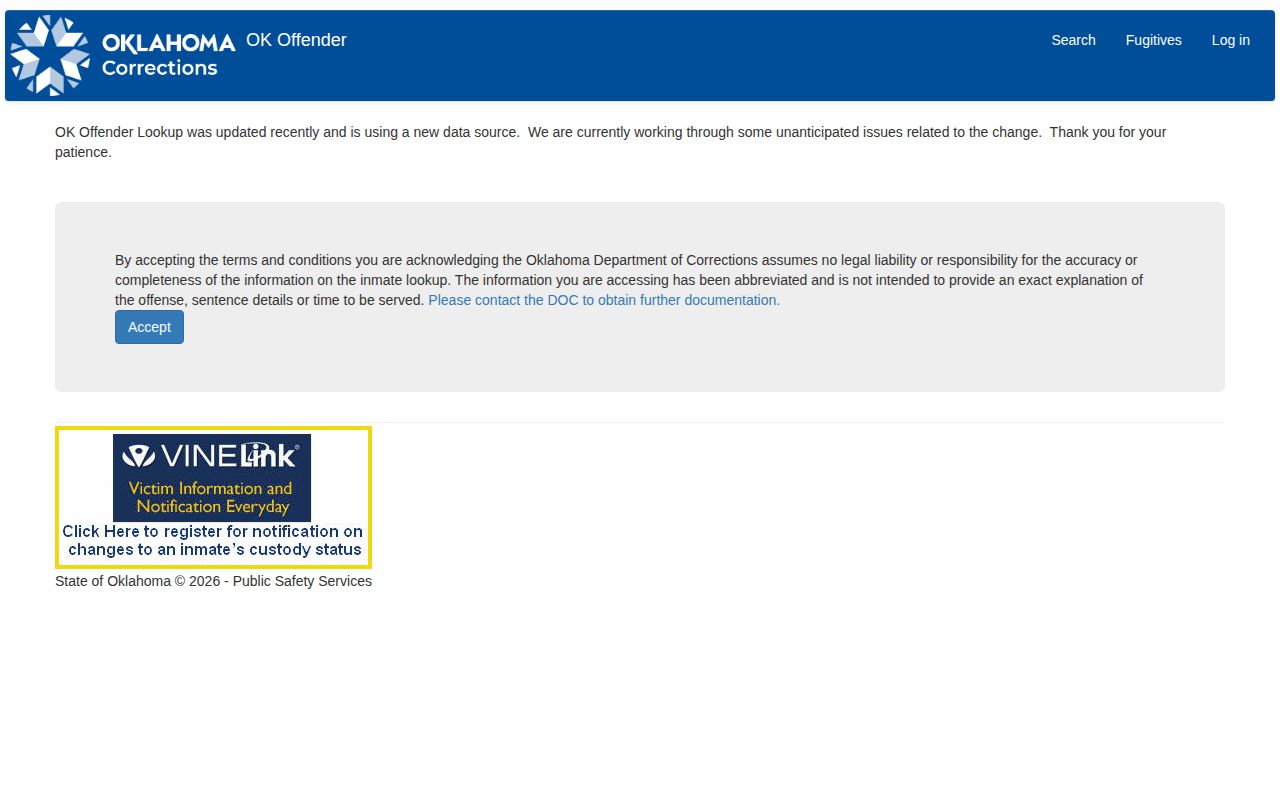
The disclaimer warns that the public material is abbreviated and may be incomplete. Compare it with court and agency records when exact sentence context matters.
The Okfuskee County released inmate search helps when the last custodian is uncertain. It separates a direct county release from an ODOC transfer, state discharge, federal event, or immigration hold.
Oklahoma Credits Shape Okfuskee Release Dates
Title 57 §138 governs ODOC earned credits. One credit equals one day of incarceration. ODOC applies credits monthly based on assigned class level. For people within the statute's specified prior felony, youthful-offender, or juvenile-history group, the monthly levels are 0, 22, 33, and 44. For people outside that group, the four levels are 0, 22, 45, and 60. The law also provides achievement credits for listed accomplishments.
Those figures are inputs, not a do-it-yourself release calculator. A valid sentence computation may need the class level, prior-history category, approved achievements, credit losses and restorations, jail credit, concurrent or consecutive terms, sentence amendments, and legal holds. Credits can be taken after due process. Restoration can occur under ODOC policy, but it is discretionary. Credits do not reduce a life sentence, and other exclusions may apply.
County time must remain separate. No Okfuskee County good-time schedule was verified. ODOC prison credit rates should not be applied to a jail booking or short county sentence. Ask the jail and court how the specific judgment, time served, and any credit are recorded. This avoids creating a date from rules that govern a different custodian.
Read Title 57 §138 in the official Oklahoma compilation for the full earned-credit rule and its limits.
Why Okfuskee Release Estimates Change
ODOC calls a release date tentative. Monthly earned-credit class, achievement awards, misconduct, and legal changes can move the estimate. The public number may also lag the working calculation held by a correctional records officer or case manager. No single calendar subtraction can capture every factor.
| Factor | Possible effect on the projected release date |
|---|---|
| Monthly class credits | Different class levels earn different monthly amounts under §138. |
| Achievement credits | Approved accomplishments can add statutory credit. |
| Misconduct and restoration | Due-process loss can extend the estimate; discretionary restoration may change it again. |
| Sentence or jail credit | Amendments and verified prior custody credit can alter the calculation. |
| Concurrent or consecutive terms | The relation among sentences changes how time is administered. |
| Detainers and warrants | Another authority may keep custody in place even when one term reaches its date. |
| Parole action | Eligibility, a hearing, and a Board result can affect the path but do not alone prove exit. |
A detainer is a request or legal basis for another agency to take or retain custody. It can turn an expected community departure into a transfer. Likewise, a favorable parole step may require later action and processing. Always confirm the receiving or releasing agency.
Okfuskee Dates and the 85-Percent Rule
Oklahoma's 85-percent rule applies to the offenses listed in Title 21 §13.1 when committed on or after March 1, 2000. For those enumerated offenses, the person must serve at least 85 percent of the imprisonment imposed before parole consideration. Earned and other credits cannot reduce actual service below that floor. The rule is not a label for every felony or every offense described loosely as violent.
Serving the minimum is not a promise of release at 85 percent. It is a floor tied to parole consideration for the listed convictions. Sentence structure, other terms, holds, and Board action still matter. The exact conviction and offense date must be checked against Title 21 §§12.1 and 13.1.
Parole eligibility has its own rules in Title 57 §332.7. General points vary by offense date and category, and some matters use exclusions or a two-stage process. PPB can consider a person before the calculated eligibility date in some circumstances, but eligibility is not a right to parole and does not certify an Okfuskee County actual release date.
Note: The 85-percent floor applies only to the statutory list and should never be used as a universal release formula.
Oklahoma PRD Access Has Limits
Official Oklahoma sources create a real access nuance. ODOC policy OP-030117 says Offender Lookup information includes the offense, projected release date, photo, and other data. PPB's glossary defines PRD, and Board dockets can publish a PRD column. Yet the current ODOC FAQ says a particular inmate's release date is confidential without legitimate need. It also calls the date tentative and says the inmate receives the days remaining each month.
The correct approach is to report what the current public record actually shows. Do not promise that every ODOC detail will reveal an exact date. If the public field is absent, the person in custody can ask a correctional records officer or case manager about the live calculation. ODOC Legal Services provides appropriate public or authorized records routes. A qualifying victim may contact ODOC Victim Services at 405-425-2607 or victim.services@doc.ok.gov.
The ODOC offender-information page is the source of the confidentiality and tentative-date warning shown below.
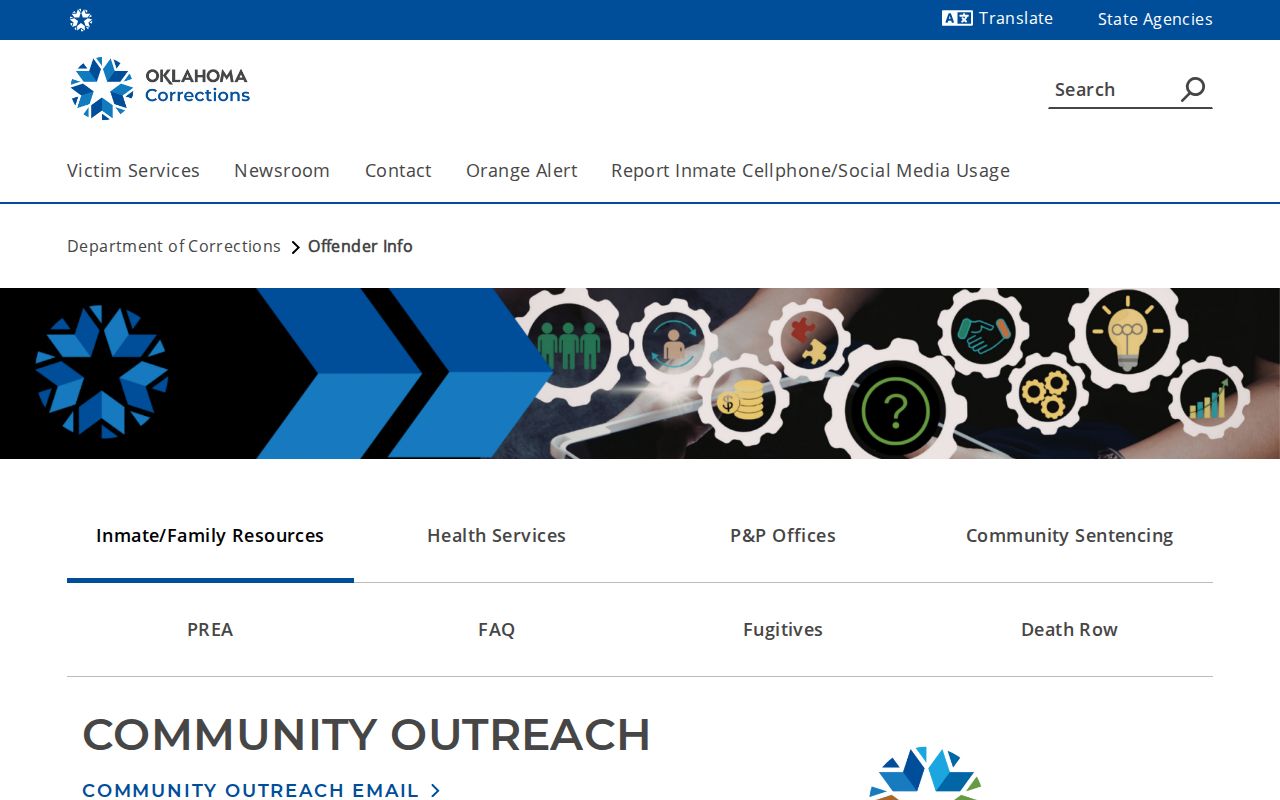
The warning explains why a published PRD, an internal current calculation, and a completed discharge must remain three separate facts.
When a public date is unavailable, do not substitute a third-party estimate. Use the channels ODOC identifies, then record the exact answer and its date. A correctional records officer or case manager can address the person's monthly remaining-time calculation. Authorized records requests and victim-service routes have their own access rules. PPB dockets are useful only when a parole matter is actually scheduled, and the docket's PRD remains an estimate rather than a confidential sentence worksheet or final release record.
Okfuskee County Dates Need Local Confirmation
No county-specific good-time schedule or weekend and holiday release rule was verified for Okfuskee County Jail. Do not import ODOC prison credits into a county sentence. Do not promise that a date falling on a weekend will become a Friday release. Jail staff and the court must explain how the actual order and sentence are entered for that person.
This local gap is important. The county holds pretrial detainees, short county sentences, and people awaiting transport. ODOC says sentenced county prisoners may normally wait six to nine months before transport to assessment or reception, with shorter sentences and court-return cases often prioritized. A person may therefore remain at the jail well after judgment, then transfer to ODOC. That movement is not community release.
Ask the jail for the existing date or manner of discharge or escape under the Oklahoma jail-register law. If the field says transfer, search ODOC and confirm the receiving custodian. If it says lawful discharge, compare it with the court record for the authority and terms.
Confirm an Okfuskee Actual Release
On the projected date or later, verify what happened. For county custody, request the Sheriff's jail-register discharge field. For state custody, read the later ODOC status and obtain discharge documentation through the proper state route. A PPB result supplies parole context, while the Holdenville Probation and Parole Office can route an Okfuskee supervision question.
OK VINE can add a participating-agency custody alert. Its event may help mark release or transfer, but data can lag and county participation should be checked in the live system. The Okfuskee County VINELink check explains one-person search and notification registration. Oklahoma uses a separate PPB program for parole notices.
Keep the terms precise. Projected means estimated. Parole means conditional release from prison. Probation is court-ordered community supervision. Discharge is the formal end recorded by the responsible agency. Transfer means custody continues elsewhere. Those labels prevent a date estimate from being mistaken for proof that someone returned to the community.